






Main menu
Objects
Your application
|
Building and reconstruction of low temperature warehouses from PRIMEHOLOD
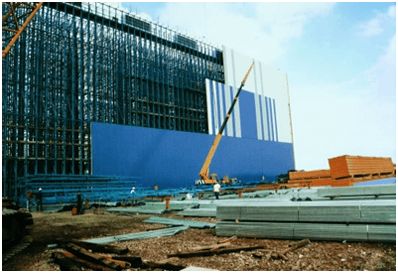
PRIMEHOLOD offers building and reconstruction of both standard and low temperature warehouses for storing a wide range of products. Low-temperature refrigeration warehouses and cameras work in the temperature modes from 0 °С to -35 °С. We guarantee high technological characteristics and choosing the best industrial refrigerating units for constructing warerooms on your order. A warehouse building takes from three to six months. The construction of warehouse complexes corresponds to what will be stored inside, the amount of products, the best temperature for storage. Air coolers are installed in chambers. They provide constant even air circulation inside. Manufacturers and suppliers of food products and beverages, logistical operators and product retailers are the major consumers of refrigerating warehouses. Low-temperature warehouses are divided into a few categories based on product specialization and corresponding temperature modes: Modern refrigerating warehouses have the following classification: Depending on the nomenclature of the stored cargo the refrigerating warehouses can be specialized or universal. Refrigerating chambers inside the warehouse are divided to low-temperature chambers (down to -30°С) - for long-term storage of frozen products, cameras for storing cooled products (from -4°С to +6°С), universal cameras (-20°С - 0°С). The structure of load-carrying ability and space-planning solutions of the refrigeration must provide progressive technology of refrigerating processing and storage of products, rational cargo traffic in the building, high level of mechanization for handling operations, modern computerized cargo control in minimal expenses for cargo processing and refrigerating means.
Modern refrigerating warehouses are impossible to imagine without storage rack systems for pallet storing, airproof, heat-insulated gates to cameras. Entry aperture must be equipped by air curtains or high-speed automatic shutters. As a rule, automobile loading ramps have closed construction with inner cooling, rehandling facilities for reception of goods. They are equipped by dock levellers, dock shelters and dock houses. All this equipment provides high speed of freight operation and minimizes cold losses, decreasing the expenses for product storage.  The floors of refrigeration warehouses have multi-layer construction including heat- and moisture-proofing with the use of modern materials, such as polystyrene and polyurethane of different density, depending on the loads on floors. If a refrigerator is built on heaving soils, it is required to secure soils from frost action to prevent the deformation of floors and the entire construction. The system of soil protection from frost effect is provided in three possible ways: by arranging blow under proof space with the distance to refrigerator floor up to 1 - 1.5 m; building an electric heat tracing system in the entire area of the refrigerated rooms; placing a hydraulic system of plastic pipes for the circulation of the heated ethylene glycol solution under floors, the coolant heating is performed by taking a part of condensation heat from refrigerator equipped by a heat exchange condenser – this method is preferable, as there are no additional expenses on electric power and engineering structures. The cooling system of refrigerated warehouses
The cooling system is selected based on the technical and economical analysis, comparing different systems by the amount of capital and operating expenses assuming the full satisfaction of all technical requirements and providing required temperature modes for products storage. Generally the solution implies a system with direct refrigeration by a cooling agent and a system with an intermediate coolant (water, brine, ethylene glycol, frizium, etc.). The advantage of systems with coolant is multiple decrease of the required amount of expensive coolant, Freon gas or dangerous ammonia. The disadvantages include bigger electric energy consumption (up to 24%) that is spent on transporting the coolant and lower coolant boiling temperature. The systems with immediate coolant boiling are usually equipped by intrachamber air coolers that provide even spreading of cooled air inside the chamber. The amount of coolant circulating via such air coolers is insignificant. The disadvantage of coolant air cooling is the need in often defrosting of chambers that imply energy expenses and temperature jumps inside the camera. Such systems with immediate coolant boiling can have or have no pump (the coolant circulation is provided by the condensation pressure). Pumping schemes are used for big, branchy refrigerating stations. 
Refrigeration units with intermediate coolant can provide required temperatures in chambers in the same range, as the units with immediate boiling. The major advantage of such units is small amount of coolant that is very beneficial when using ammonia. It helps to reduce expenses on initial loading and further reloading by coolant (Freon gas, ammonia, CO2). Decrease of coolant amount also improves the operation security. Increase of capital expenses on additional equipment is major disadvantage of such systems. The newest tendency in refrigeration warehouses design and construction is using carbon dioxide (CO2) as a cold carrier instead of expensive Freon gases (the cost of CO2 is in tens of times smaller). Carbon dioxide belongs to natural substances that do not destroy the ozone layer as opposite to Freon, whose application is restricted by Kyoto Protocol. Leading European manufacturers have developed compressors and refrigeration system components working on CO2. Refrigerating systems based on CO2 provide high EFF, higher than Freon or ammonia in low-temperature range. CO2-based systems use subcritical or transcritical cycles, and therefore - cascade or single-staged scheme. The problems of using CO2 in refrigerating units include higher requirements to materials and quality of assembling due to high operating pressures in the system and risk of incidental pressure - up to 70 atm. However, CO2-based refrigerating systems are compact in size and provide significantly lower materials consumption.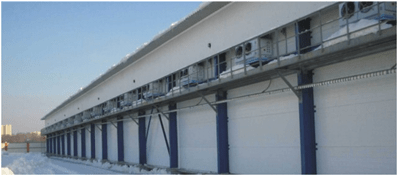 It is recommended to use local Freon refrigerationunits for small refrigerating warehouses with up to 2000 t capacity. They must work in automatic mode that provides the
 |
We offer
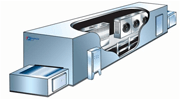
Fast-freezing tunnels We offer
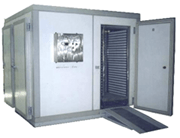
Shock-freezing chambers We offer
Ammonia refrigeration units |




|
|


