






Main menu
Objects
Your application
|
PRIMEHOLOD offers services for design, installation and service maintenance data center cooling systems.The cost of consumed electric power is about 50% of operating costs for the maintenance of DPC (data processing center). In typical DPC 50% of power is consumed by IT-equipment, about 40% - by a cooling system and 10% - by uninterrupted power supply system. Classic solutions with refrigerating equipment are used in data centers for arranging “hot” and “cold aisles”. Applying a chilling fluid with a temperature higher than condensate formation point (18-21°C) helps to prevent condensate formation. This allows obtaining 24°C air temperature in rooms, increase the chiller efficiency (up to 35%) and its operating time in natural cooling mode during a year. Also it is important to take into account rather complex problem related to transferring big amount of heat from each maximally filled rack emitted by hardware operation. It is possible to use solutions from IBM and DELL to calculate the amount of emitted heat: Solution from IBM Solution from Dell It appears that one fully loaded rack requires a cooling airflow from 4000 to 5000 m3/h. Let’s consider a few standard approaches to air cooling in DPC and find out, how to solve the problem of cooling server racks that emit from 15kW to 25 kW of heat without using liquid coolants.
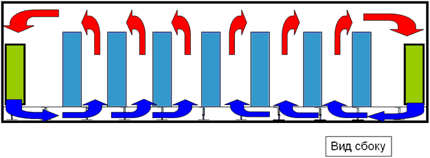
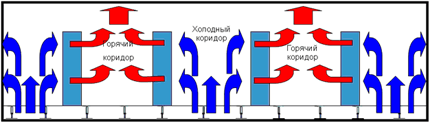
If the load in DPC is from 3kW to 6kW, a cooling system with “hot” and “cold” aisles is required. Cold air gets via the grids in the installation floor and is directed to the front of the server racks. Two rows of server racks are installed facing each other and form a zone of cold air supply that is called a “cold” aisle. Hot air is output on the back of server racks into an isle that forms a hot air zone – a “hot” aisle.
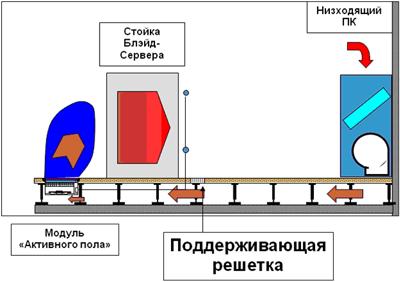
If it i required to withdraw more than 10-15 kW of heat from each server rack, an “active floor” solution is applied. The main idea of “active floor” cooling is the supply of much bigger controlled airflow (up to 4500 m3/h instead of 800-1000 m3/h from a standard 600 X600 mm grid).
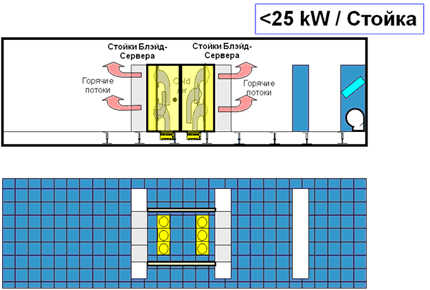
It would not be enough simply to install a ventilator in floor void to provide a guaranteed server racks cooling. It is highly important to arrange the airflow both by pressure and air direction to provide the air supply not only to the top of each rack, but also to its lower part, if such need occurs. Besides a ventilator, an “active floor” panel is equipped by a processor, temperature indicators and turning lamellas. Long operational life is an important characteristic of such system. The samples of “active floor” implementation for horizontal and vertical flows spread on two zones are shown below. Schemes of solutions based on an “active floor” approach (15-25 kW on each rack)
The application of “active floor” scheme helps to increase the heat radiation capacity of each rack to 25 kW. A sample of solution with “active floor” and “cooling basin”.
The advantages of “active floor” solution Types of module solutions for DPC cooling Nowadays a “module data center” term is applied to three types of technological areas, including: Precision conditioners with direct expansion (DX). Freon precision conditioners with remote air-cooled condensers are still rather popular as coolers for small DPC of Tier I or Tier II level according to Uptime Institute classification. The major advantages of Freon conditioners include low capital expenses for equipping data centers with cooling systems, long operation life, and comparatively high reliability. Such type of products is produced by numerous world manufacturers. DX-conditioners is a good choice for small (up to 100 kW) data centers with low requirements to the core processes consistency. Freon precision conditioners with water cooling of condensers and natural cooling systems based on dry cooling towers help to decrease the yearly electric power consumption approximately by 35%. In summer such equipment can consume slightly more power, as recirculation pumps also operate besides compressors, ventilators and cooling towers. Recirculation pumps provide the circulation of coolant in “conditioner - cooling tower” circuit. However, it is possible to use environmental cold when the outside air temperature gets lower, switch off compressors that consume the biggest part of energy in conditioners. Cold carrier based precision conditioners. Currently it is the most popular cooling solution for Tier I – Tier IV class data centers. The main idea of this technology is cooling air in a heat-exchange unit by cold carrier circulation cooled in special machines - chillers. The cooling system consists of a chain of elements. Their correct and efficient functioning plays an important role in continuous cooling process, so important for high level DPCs.
|
We offer
Fast-freezing tunnels We offer
CO2-based refrigerating equipment We offer
Liquid coolers |




|
|


